Grain
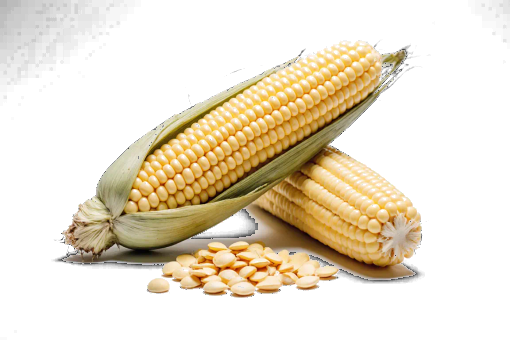
Choclo (Chilean corn)
Zea mays
Mildly sweet and milky when raw, with the smell of freshly cut corn; cooked, it turns creamy, with notes of warm milk and butter and a toasted background that recalls bread.
Aroma compounds
The volatile molecules behind its aroma. Each one adds a distinct note.
- Dimethyl sulfide cooked-corn and sea-air aroma, intense in freshly boiled kernels
- 2-Acetyl-1-pyrroline popcorn and fresh-bread note that appears as the paste cooks
- Hexanal green and grassy, the smell of the raw kernel and the husk
- Furaneol caramel and ripe fruit, formed as the topping browns in the oven
In the kitchen
In Chile, choclo is the tender corn eaten as a vegetable, and the one in traditional recipes is not canned sweetcorn: it is large-kernel, yellowish-white, starchy varieties, humero and pastelero, which grind into a thick, starchy paste. That paste, cooked slowly with onion, basil and lard, is the base of humitas, wrapped in their own husks, and of the topping of pastel de choclo, browned in the oven with sugar on top. Whole and in pieces it goes into the beef cazuela, where it releases starch and sweetens the broth, and as kernels it can be added to the creamed Swiss chard as an option. It is grated or ground raw, never cooked, and the paste is cooked while stirring until it thickens.
- Basil
- Lard
- Onion
- Beef
- Cheese
- Pumpkin
How to choose, store and substitute it
How to choose it
Choose ears that feel heavy for their size, with green, tight husks, moist pale silks and large, tightly packed kernels of creamy white or pale yellow; pressing a kernel with a nail should release a milky liquid, not water or dry flour. For humitas and pastel ask for choclo humero or pastelero, not sweetcorn; for the cazuela, any fresh ear works. The wide, whole husks are part of the ingredient in humitas, so do not discard them at the market.
How to store it
With husks and unwashed, in the fridge, it keeps 2 to 3 days; after that the sugar turns to starch and the kernel becomes hard and pasty. Cut off the cob or ground, the raw paste freezes for up to 6 months in flat bags, and cooked humitas freeze wrapped for up to 3 months. Whole cooked choclo keeps 3 days refrigerated.
What to use instead
- Frozen corn kernels: the same weight; sweeter and less starchy, so add one or two tablespoons of cornflour or fine semolina to the paste so it thickens.
- Canned sweetcorn, drained: the same weight, with less salt in the recipe and a tablespoon of cornflour per 500 g to give the paste body.
- Precooked cornmeal cooked in milk: one part cornmeal to three parts milk until it forms a thick paste, in the same volume as the choclo paste the recipe asks for; the texture changes, but it rescues a pastel out of season.
- Tender ears of other corn varieties for the cazuela: the same amount in pieces; they cook the same, though they sweeten the broth more.
Frequently asked questions about choclo (chilean corn)
What is choclo?
It is the name given in Chile and other Andean countries to the tender corn eaten as a vegetable, above all the large, starchy-kernel varieties such as humero and pastelero. It is sold fresh in summer, with its husks, and used whole in the cazuela or ground in humitas and pastel de choclo.
Why is Chilean choclo not sweetcorn?
Because they are different varieties. The sweetcorn sold canned or frozen has small, yellow, very sugary kernels, and it turns watery when ground. Choclo humero or pastelero has large, white kernels rich in starch, which grind into a thick paste that sets on its own as it cooks; that is why humitas and the pastel topping are made with it.
How is choclo grated or ground?
The kernels are cut from the cob with a knife, close to the core, and then ground in a food processor or blender in batches, with a little milk if needed, into a coarse paste with no whole kernels left. The whole ear can also be grated on a coarse grater, which is the traditional method. It is never cooked before grinding.
How much does one ear of choclo yield?
A large ear gives between 150 and 200 g of kernels, so the paste for a pastel de choclo with 1.2 kg of kernels needs 6 to 8 ears, and the humitas, with 1.6 kg, about 8 to 10. Buy one or two extra: there is always one with sparse or overripe kernels.
Can choclo be frozen?
Yes, in two ways: raw kernels cut from the cob, in flat bags, for up to 6 months, or already ground into paste, in recipe-sized portions, which thaw in the fridge and cook just like fresh. Cooked humitas also freeze wrapped and are reheated in boiling water without thawing.