Sweetener
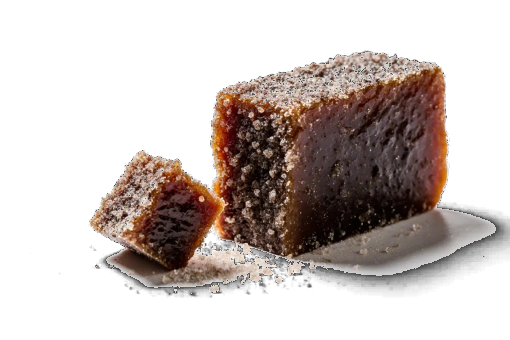
Chancaca (raw cane sugar)
Deep cane sweetness with notes of dark caramel, molasses and liquorice, a toasted hint close to coffee and a faintly sour backbone that white sugar never has.
Aroma compounds
The volatile molecules behind its aroma. Each one adds a distinct note.
- Furaneol cooked caramel and fruit, the sweet heart of molasses
- Maltol burnt sugar and candy floss, rounds off the sweetness
- Acetic acid a sour, slightly vinegary edge typical of concentrated cane juice
- 2,5-Dimethylpyrazine toasted and nutty, from the long boiling of the juice
- 2-Acetylpyrrole toasted bread and caramel, with a hint of walnut
In the kitchen
Chancaca is unrefined cane sugar: the cane juice is boiled until almost all the water has evaporated and poured into moulds, where it sets into dark loaves or blocks that keep the whole molasses. In Chile it is hardly ever used dry: it is dissolved in water with orange peel, cinnamon and cloves and reduced into miel de chancaca, the thick syrup that coats sopaipillas pasadas, the winter dessert of rainy days, and picarones. On this site it appears in the sopaipillas recipe, which explains the version dipped in hot chancaca syrup, and in the mote con huesillo, whose syrup can be made with sugar or with chancaca for a darker colour and a more traditional flavour. It also sweetens cocadas, the cornstarch alfajores of northern Chile and some versions of leche asada. Outside Chile it belongs to the same family as Colombian panela, Mexican piloncillo and Brazilian rapadura, and they swap freely.
- Orange
- Cinnamon
- Cloves
- Pumpkin
- Peach
- Walnuts
How to choose, store and substitute it
How to choose it
Choose a hard block, dry to the touch and an even dark brown, with no white patches of recrystallised sugar and no damp or sticky areas, which mean it has absorbed moisture. It should smell of molasses and caramel, never fermented. Small loaves of about 250 to 500 grams are used up before they soften. If it is sold grated or granulated, check that it has not caked. Panela and piloncillo from Latin American shops work just as well: what matters is that it is whole cane sugar, not light brown sugar coloured with molasses.
How to store it
Well wrapped in its paper or in an airtight jar, in a cool dry place, it keeps for more than a year without losing flavour; it hardens further with time but remains good. If it gets damp it turns sticky and the surface can ferment, so keep it away from kitchen steam. To break it, wrap it in a cloth and tap it with the handle of a knife, or grate it on a coarse grater. Ready-made chancaca syrup keeps in a closed jar in the fridge for 2 to 3 weeks; if it crystallises, warm it with a tablespoon of water and it runs again.
What to use instead
- Panela, piloncillo or rapadura: the same amount; they are the same product under another name.
- Light or dark brown sugar: the same amount plus one tablespoon of molasses per 100 g to recover the colour and the toasted depth.
- White sugar with molasses or cane syrup: 90 g of sugar and 2 tablespoons of molasses per 100 g of chancaca; it comes out less deep.
- Honey for the sopaipillas syrup: three quarters of the weight, reduced for less time because it is already liquid; the flavour changes.
Frequently asked questions about chancaca (raw cane sugar)
What is chancaca?
It is unrefined cane sugar, made by boiling cane juice until almost no water is left and letting it set in moulds. It keeps all its molasses, which is why it is dark, moist and deep in flavour, and it never goes through the centrifuging that separates white crystals. In Chile it is sold in blocks and is the base of the miel de chancaca poured over sopaipillas pasadas and of some syrups, such as the one for mote con huesillo.
How is miel de chancaca made?
The block is broken into pieces and simmered in water, about 250 g of chancaca to half a litre, with orange peel, a cinnamon stick and two or three cloves, until it dissolves and the syrup thickens enough to coat the back of a spoon, 15 to 20 minutes. Some households bind it with a teaspoon of cornflour dissolved in cold water. The sopaipillas are dipped in that hot syrup for a few minutes and served warm.
How does chancaca differ from panela and piloncillo?
In nothing essential: all three are cane juice concentrated and set without refining, and the name and shape change with the country. Colombian panela usually comes in discs or rectangular blocks, Mexican piloncillo in cones and Chilean chancaca in round or rectangular loaves. They may vary in moisture and in how dark they are depending on the cooking point, but they replace each other one for one in any recipe.
Can I replace chancaca with sugar?
Yes, but the result will be flatter. Chancaca brings molasses, a toasted depth and a sour edge that white sugar lacks. The closest option is light or dark brown sugar in the same amount with a tablespoon of molasses added per 100 g; with white sugar alone the syrup stays pale and neutral, closer to a plain simple syrup than to traditional miel de chancaca.
How long does chancaca syrup keep, and how do I rescue it if it crystallises?
In a closed jar in the fridge it lasts 2 to 3 weeks without trouble, and the undissolved block, kept dry, more than a year. If the cold syrup crystallises or turns too thick, warm it gently with a tablespoon of water, stirring until it flows again. Make it in small batches and do not boil it hard a second time, because it keeps concentrating and can reach the caramel stage.